Designed for real tables, not ideal inputs.
Custom Poker Data & Vision Systems
Poker Vision: poker OCR, Poker Reader & equity analysis
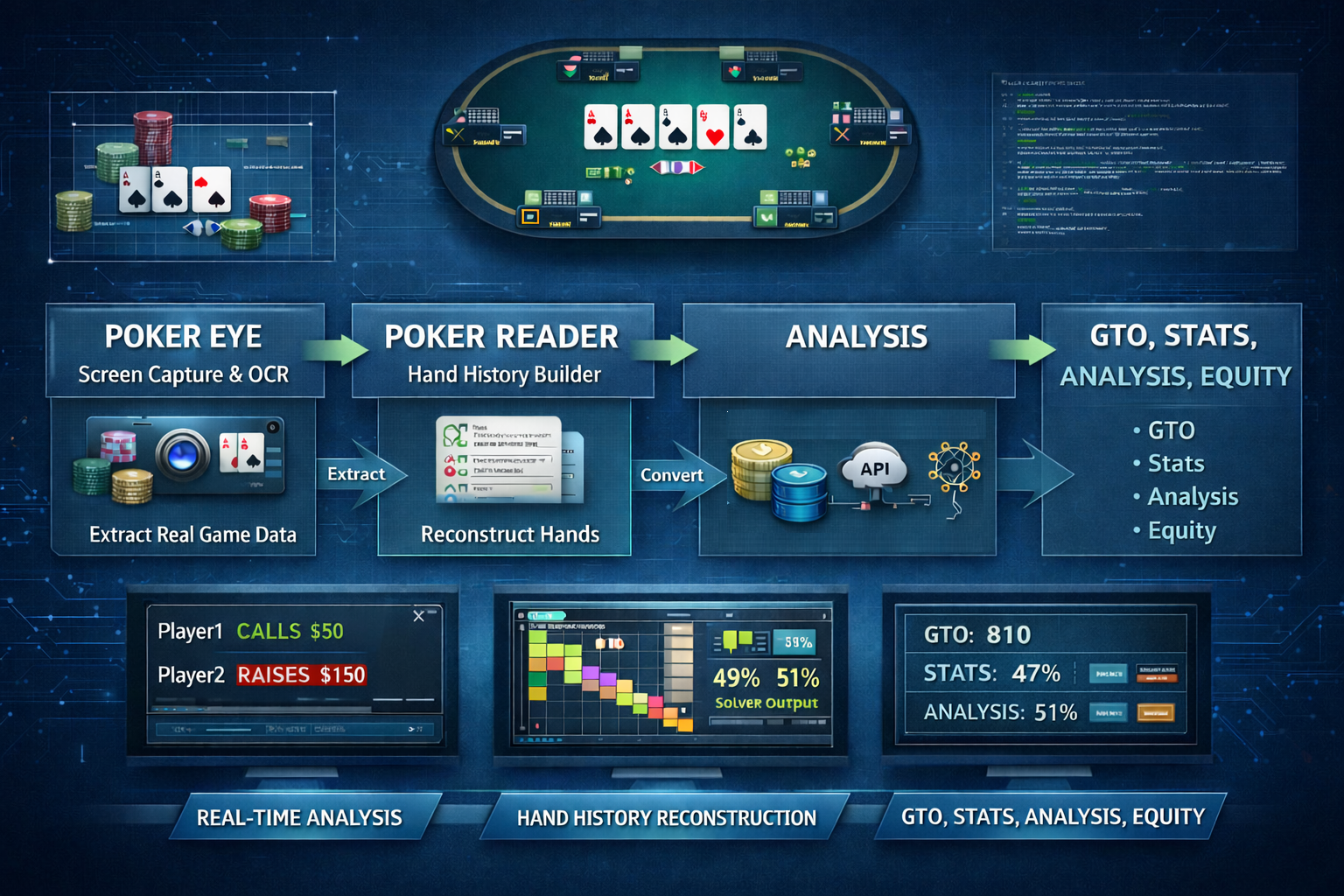
Extract table data, reconstruct hand histories, and derive player fields, game state, analysis metrics, and equity calculations in one pipeline.
I build custom poker OCR and computer vision systems that convert table visuals into structured records similar in spirit to classic hand histories: seats, stacks, cards (when visible), board runouts, and street-by-street progression—so you can study how state evolves and run equity and stats workflows offline or in permitted research settings.
Not auto-play. Poker automation here means data-capture and analytics automation—not in-game autopilot. Research on poker bot / Poker BOT and Poker RTA signals is analysis-only. This site does not promote gambling or policy-violating use.
Overview
I build custom poker OCR and computer vision systems that convert table visuals into structured, usable data. The process starts with Poker Eye, which extracts cards, stacks, bets, and UI elements directly from the screen. Poker Reader then reconstructs complete hand histories by tracking plays, sequencing events, and handling missing or delayed information.
From those histories we normalize players (identities, seats, stacks), game state at each street (board, pot, effective stacks, visible cards), and the betting progression, then compute analysis metrics and equity-style estimates—for example, showdown equity against assigned or learned ranges—plus aggregated stats for review and training datasets.
The system is modular and can run in real time or offline, depending on the use case. It is built for real environments—handling UI inconsistencies, animations, and the absence of direct data access.
Related searches: Poker OCR, Poker Reader, Poker Vision, automation, bots
If you landed from queries like poker OCR, Poker Reader, Poker Vision, poker automation, or poker bot, here is how those terms apply.
- Poker OCR — screen-based optical character recognition and vision to read cards, stacks, bets, and UI from table clients.
- Poker Reader — our hand-history reconstruction module (plays, seats, stacks, boards, pots) built on top of extracted pixels.
- Poker Vision — the umbrella project and GitHub repository for this work and this site.
- Poker automation — automation of data pipelines (capture, parsing, exports, stats jobs), not auto-playing decisions in the client.
- Poker bot — on this site, bot work means detection signals and research analytics, not operating bots at tables.
Hire / order: This page is the Poker Vision project site; paid poker OCR work with reviews and checkout runs through our Poker OCR gig on Fiverr (fiverr.com/hasanaat/do-poker-table-ocr). Linking the gig and this site helps visitors—and search engines—see one consistent offering.
Primary outcomes
What engagements are optimized to deliver—pick the subset that matches your product.
- Accurate extraction of cards, stacks, bets, and positions from screen
- Clean, structured hand histories with correct play sequencing
- Real-time or offline processing
- Street-by-street game state aligned with seats, stacks, board, and pot
- Equity-style calculations per decision point (ranges, boards, runouts)
- Automated stat generation from parsed hands
- Reduced manual effort in tagging and reconstruction
- Scalable data pipelines for analysis and training
- Works from the screen without operator data feeds; optional file or database exports for your stack
- Handles animations, delays, and incomplete data
Glossary
Short definitions for terms used on this page.
Terms at a glance
- OCR
- Extracts text and numbers from screen images.
- Computer vision
- Detects visual elements like cards and UI components.
- Hand history
- Structured record of a hand: format, seats, stacks, visible cards, community cards, and how the hand progresses street by street—similar to published hand-history concepts used across online poker tools.
- Players
- Who is seated, stack sizes, positions, and any hole cards the UI exposes.
- Game state
- Snapshot after each decision point: board, pot, stacks, street, and betting line so far.
- Analysis
- Quantitative summaries derived from reconstructed hands—frequencies, pot geometry, stack-risk metrics, and review-oriented rollups you define.
- Poker Vision
- Project name for this poker computer-vision stack and the public GitHub repo
azbvision/PokerVision. - Poker Eye
- Visual extraction module.
- Poker Reader
- Hand reconstruction engine: builds structured hand histories from Poker Eye output.
- Equity
- Estimated probability of winning at showdown (or splitting), given known cards, board runout so far, and assumptions about opponent ranges—standard in hand-review and study tools.
- Stats
- Aggregated gameplay metrics.
Process & timeline
From requirements through delivery—aligned to how modular pipelines are built.
- Requirement review + sample analysis
- Poker Eye development (data extraction)
- Poker Reader development (hand reconstruction)
- Players & game-state modeling (schema, validation, enrichment)
- Stats & equity implementation
- Testing with real scenarios
- Iteration and final delivery
Modular pipeline & services
End-to-end flow is Eye → Reader → Players & state → Analysis & equity. Engage for one module or the full chain—each block below solves a specific gap.
Poker Eye (OCR / computer vision)
Extracts cards, stacks, bets, positions, and UI states directly from table visuals.
Solves: Removes dependency on operator data feeds by reading raw screen pixels.
Poker Reader (hand history engine)
Converts extracted data into structured hand histories by tracking plays, sequencing events, and resolving missing information.
Solves: Rebuilds full hand flow from imperfect visual input.
Players & game-state layer
Normalizes seats, identities, stacks, positions, visible hole cards, board runouts, pot and stack deltas, and street-by-street progression into a single schema your analysis jobs can trust.
Solves: Turns messy UI into coherent player and state objects for metrics and equity pipelines.
Stats & equity engine
Computes equity-style numbers, frequency tables, and rollups from reconstructed hands and derived state—suited to review tools and research datasets.
Solves: Turns raw hand data into usable insights.
Offline analysis system
Processes videos, screenshots, or manual inputs to generate hand histories and analytical outputs.
Solves: Enables post-session review without live dependency.
Who this is for
Demo videos & prior work
Tech stack & architecture
- C# (core development)
- Custom OCR and computer vision pipelines
- Modular flow: Eye → Reader → players & state → analysis & equity
- Real-time and offline modes
- Exports for databases, logs, and hand-history-style formats (optional PokerTracker-style paths when you own imports)
- Open project repo: github.com/azbvision/PokerVision
- Optional AI models (GPT-style)
- Windows desktop environments
- Handles asynchronous UI and animations
- Outputs: structured logs, databases, analytics-ready data
Designed for reliability, maintainability, and handoff to your downstream stack.
Why custom vision work
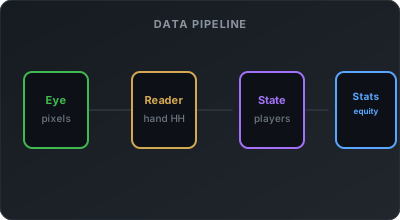
Layouts, timings, and table logic differ by client and platform. Custom Eye and Reader logic target your environment—not a generic template—so accuracy and maintainability match what you actually run.
Engagements stay modular: Poker Eye only, add Reader, players & state modeling, analysis & equity metrics, or offline review—scoped to what you need.
Frequently asked questions
How does this site connect to the Poker OCR Fiverr gig?
This GitHub Pages site documents Poker Vision and Poker Reader. Paid poker OCR orders, reviews, and checkout run through our Fiverr gig. Linking both ways helps people and search engines treat them as one offering.
Do you need a poker site API?
No. It works directly from the screen.
Can it handle animations and delays?
Yes. That is handled in the Reader logic.
Real-time or offline?
Both are supported.
Can it export data for external analysis tools?
Yes. Deliverables can include structured logs, databases, or hand-history-style exports you specify so your own analysis, stats, and equity workflows can consume them.
Does it provide equity and stats?
Yes, it can provide those.
Is it modular?
Yes—it is developed in modules.
What do you need to start?
Desktop screen recordings, expected export formats, and the player and game-state fields you need for analysis and equity calculations.
Is this PokerTracker or official Poker Tracker software?
No. This is independent custom poker OCR and a Poker Reader engine. Hand-history or stats-oriented exports can sometimes be mapped into PokerTracker-style review workflows if you own the import path—we are not affiliated with PokerTracker, Max Value Software, or any tracker vendor.
What is Poker Vision on this site?
Poker Vision is the project name for this poker computer-vision work, including the public GitHub repository azbvision/PokerVision and this landing page.
What is Poker Reader here?
Poker Reader is the hand-history reconstruction module: it turns extracted table pixels into structured sequences of plays, seats, stacks, boards, and pots suitable for downstream analysis and equity calculations.
Does poker automation mean a bot auto-plays for me?
No. Poker automation here means automating capture, parsing, and analytics pipelines (OCR jobs, log writers, stats refresh)—not automating in-game decisions or bypassing client terms.
Do you support Poker BOT and Poker RTA analysis?
Yes. We can implement Poker BOT detection signals and Poker RTA risk analytics for analysis and research workflows in permitted environments.
Start a project
Hourly preferred; milestone structure optional. Typical inputs: screenshots or videos, platform details, and expected outputs. Deliverables can be individual modules or a full pipeline.
If you need extraction, hand-history reconstruction, player and state modeling, analysis metrics, equity calculations, or offline review, send a focused inquiry.
Ask a question
Short questions only—we will email you back when we can. Add your email if you want a reply.
Prefer email? azbvision.zain@gmail.com
Contact
Serious inquiries only. Please provide:
- Platform and table screenshots or videos
- Required outputs (hand history schema, player fields, game state, equity metrics, stats)
- Real-time or offline requirement
- Downstream analysis or ML tooling expectations
All projects are handled with strict confidentiality.
Engagement model
- Hourly preferred; milestone optional
- Requirements: screenshots/videos, platform details, expected outputs
- Deliverables: individual modules or full pipeline